
Sunscreen vs Light-Filtering Blinds: What Is the Difference?

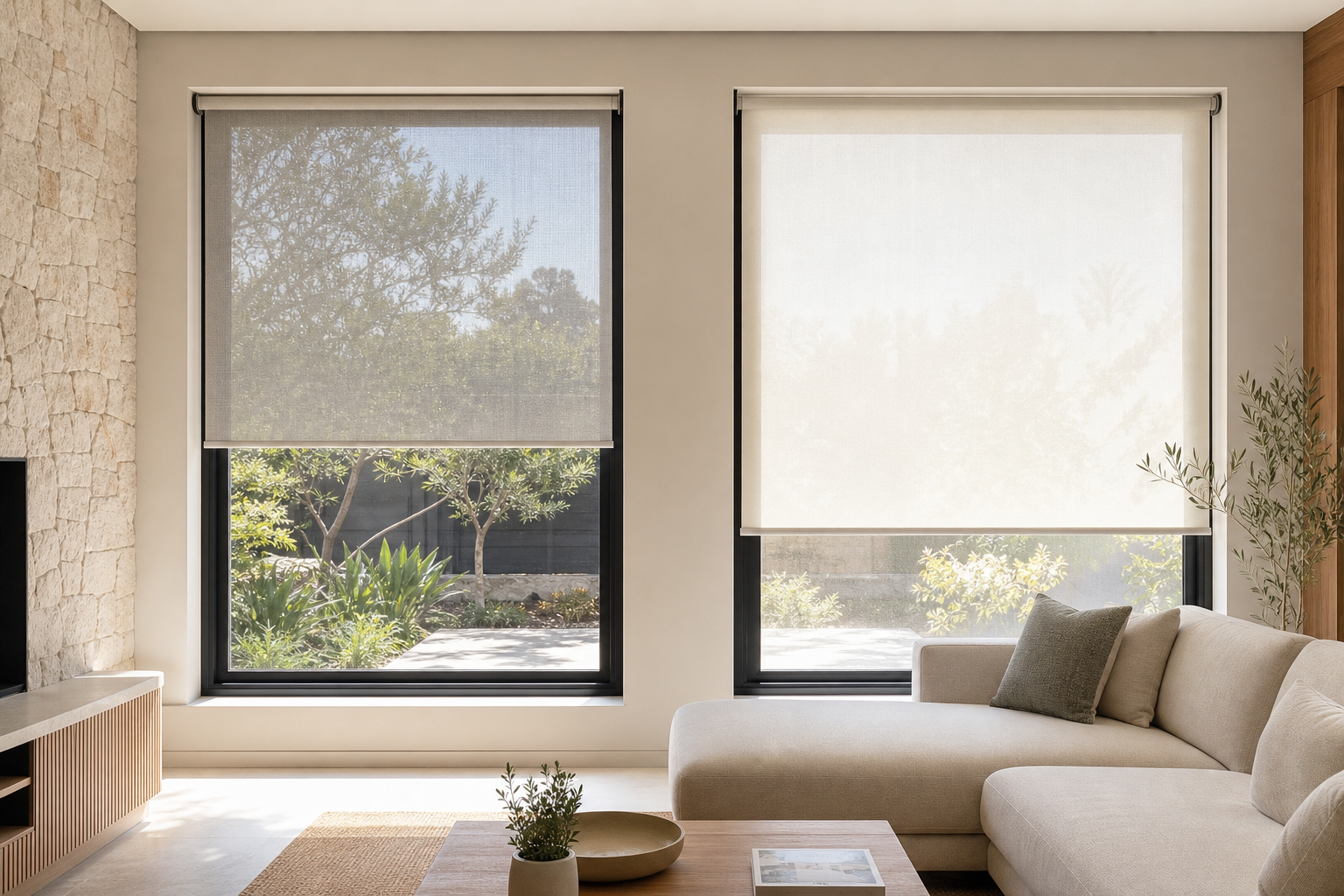
Sunscreen and light-filtering roller blinds both soften strong daylight, but they do not create the same result. Sunscreen fabric is designed to filter glare while retaining more daytime outward visibility. Light-filtering fabric diffuses the view and spreads softer light through the room. The better choice depends on whether your priority is the view, privacy, glare control or a calmer interior atmosphere.
This guide explains the practical difference between sunscreen and light-filtering blinds for South African homes, offices and hospitality spaces. It also covers night-time privacy, fabric colour, room choice, layering and the installation details that affect the finished result.
Quick answer: sunscreen or light filtering?
| Requirement | Sunscreen blind | Light-filtering blind |
|---|---|---|
| Daytime outward view | Retains more visibility through the fabric | Diffuses or obscures the view |
| Glare reduction | Strong choice for sunny rooms and screens | Softens bright light more evenly |
| Daytime privacy | Improves screening while outside is brighter | Creates a more obscured daytime boundary |
| Night-time privacy | Visibility changes when lights are on inside | Depends on fabric opacity, colour and indoor lighting |
| Interior effect | Clean, view-aware and architectural | Soft, calm and more visually enclosed |
| Typical rooms | Living rooms, studies, offices and view-facing spaces | Living areas, passages, guest rooms and spaces needing diffused light |
Neither option is automatically better. Start with what the room needs to do when the blind is lowered.
What is a sunscreen roller blind?
A sunscreen roller blind uses an open-weave performance fabric that filters direct light and glare while allowing a degree of outward visibility during the day. The weave is often described by an openness factor, although the exact ranges and performance vary by approved fabric collection.
Sunscreen blinds are useful where closing the blind should not remove the room’s connection to the outside. A living room facing a garden, a study with screen glare or an office with large glazing may benefit from this balance.
The blind does not make the glass disappear or guarantee privacy. The result changes with the difference between indoor and outdoor light. During the day, a brighter exterior supports stronger inward screening. After dark, when interior lights are on, people outside may be able to see through the fabric more easily.
What is a light-filtering roller blind?
A light-filtering roller blind uses translucent fabric to diffuse daylight across the window. Instead of preserving a clear outward view, it creates a softer visual boundary. The room remains brighter than it would with a blockout blind, but the window feels more screened and the incoming light becomes more even.
Light-filtering fabrics vary. A pale, loosely woven fabric can behave differently from a denser or darker option. The amount of visible silhouette after dark also depends on the fabric, distance from the window and strength of the interior lighting. Light filtering should not be treated as a universal guarantee of night-time privacy.
The main difference is the view
If the landscape, garden or outlook matters while the blind is lowered, sunscreen fabric is usually the stronger starting point. Its open construction retains more daytime visibility. A light-filtering blind is chosen when diffused light and a calmer screen across the window matter more than seeing through it.
Stand in the room and decide whether the lowered blind should behave like a filter or a soft visual screen:
- Choose a sunscreen starting point when glare is the problem but the view should remain more visible.
- Choose a light-filtering starting point when the window should glow softly without a clear view through the fabric.
How the two fabrics manage glare
Both fabrics can reduce the intensity of bright daylight, but they do it differently. Sunscreen mesh filters the incoming light while maintaining more visual connection to the exterior. Light-filtering fabric scatters the light and reduces the contrast of the bright window against the room.
For a television or computer screen, the source and angle of the reflection matter. A correctly specified blind cannot fully compensate for a screen positioned directly into intense sun. Consider the window orientation, the time glare occurs and the position of the screen during the measure.
Daytime and night-time privacy
Privacy is not a fixed property of a fabric viewed in isolation. It depends on which side is brighter.
Sunscreen privacy
During the day, sunscreen fabric can make it harder to see into the room while allowing the occupant to retain more of the outward view. At night, the light relationship reverses and visibility from outside can increase. Use a second layer where dependable evening privacy is important.
Light-filtering privacy
Light-filtering fabric obscures the outward view more strongly and can create useful daytime screening. After dark, silhouettes or movement may remain visible through some fabrics. Review a physical sample with the likely interior lighting before treating it as an evening privacy solution.
Fabric colour changes the effect
Colour affects both appearance and the way the fabric interacts with the view. Dark sunscreen fabrics often make the outward view appear clearer because the eye looks past the darker weave. Pale sunscreen fabrics can feel softer and more integrated with a light interior, while making the mesh more visually present.
Light-filtering colour affects the atmosphere of the transmitted light. Warm white may create a softer glow, while grey or natural tones can reduce brightness and coordinate with stone, timber or charcoal finishes. Colour displayed on a phone or computer is not reliable enough for final selection. View physical samples against the actual window and surrounding materials.
Which rooms suit sunscreen blinds?
Living rooms
Sunscreen rollers can soften low sun and preserve more of a garden or landscape view. If night-time privacy matters, pair them with curtains or another suitable layer.
Home offices and studies
They can reduce screen glare without making the workspace unnecessarily dark. Check the desk position and direction of direct sun.
Commercial offices
Consistent sunscreen specifications can help manage glare across larger glazed areas. Opening dimensions, facade orientation and coordinated installation still need project-specific planning.
View-facing rooms
Where the reason for the window is the outlook, sunscreen fabric usually preserves more of that value while the blind is in use.
Which rooms suit light-filtering blinds?
Guest rooms and passages
Light-filtering fabric can keep circulation and occasional-use spaces bright while softening the window visually. Review evening privacy if the room is overlooked.
Living and dining areas
A translucent roller can create calm, even daylight where a direct outward view is not the priority.
Street-facing windows
Light filtering can provide a stronger diffused boundary than sunscreen mesh during the day. It should still be assessed after dark before relying on it as the only privacy layer.
Layered interiors
A light-filtering blind can sit behind curtains to provide a simple daytime mode while the curtain supplies texture and stronger evening enclosure.
When neither option is enough
Sunscreen and light-filtering blinds are not designed to provide the same darkness as an opaque blockout fabric. If sleep, media-room contrast or strong room darkening is the main objective, compare a blockout blind and plan the edge gaps, mounting position and overlap as part of the result.
Read the blackout blinds planning guide.
If a room needs daytime glare control and stronger privacy or darkness later, a layered treatment may work better than one fabric. Options can include:
- a sunscreen roller blind with bespoke curtains;
- a light-filtering roller blind with lined curtains;
- a suitable double-roller configuration; or
- different fabrics across coordinated rooms rather than one fabric throughout the home.
Available configurations and motorisation suitability must be confirmed for the dimensions, system and installation.
Fit and measurement still matter
The fabric choice cannot compensate for an unsuitable fit. Measurement should account for recess depth, handles, opening direction, security fittings, sill projection, fixing surfaces and the position of the control.
A recess fit gives a compact appearance but requires sufficient depth and leaves normal operating clearances. A face fix can increase overlap where the surrounding wall and trim permit. Wide openings may need to be divided, linked or motorised rather than covered by one blind.
Compare the complete roller blind range.
Can sunscreen and light-filtering blinds be motorised?
Many suitable roller-blind configurations can be motorised, especially for high, wide, grouped or frequently operated windows. Suitability depends on the dimensions, system, power source, controls and maintenance access. Smart-home integration should be confirmed for the selected components rather than assumed.
Questions to answer before choosing
- Do you want to retain the daytime view when the blind is lowered?
- Is the main problem direct glare or generally bright daylight?
- Do you need privacy during the day, after dark, or both?
- Will the blind work alone or with curtains?
- Which colour and weave look right against the real window?
- Is the opening wide, high or difficult to operate manually?
- Does the recess provide enough depth and clearance?
Sunscreen vs light-filtering blinds FAQ
Can you see through sunscreen blinds at night?
Visibility changes when the exterior becomes darker and interior lights are on. Sunscreen fabric should not be promised as complete night-time privacy. Add a suitable second layer where evening privacy is essential.
Can you see through light-filtering blinds?
They obscure the view more than sunscreen fabric, but some materials may still reveal silhouettes after dark. The selected sample should be assessed under realistic lighting.
Do light-filtering blinds block glare?
They soften and diffuse bright daylight. Sunscreen fabric may be preferable where glare control and retaining more of the outward view need to happen together.
Are sunscreen blinds the same as blockout blinds?
No. Sunscreen mesh filters light and retains more daytime visibility. Blockout fabric is opaque and stops light passing through the material, although edge gaps still affect the installed darkness.
Which option is better for a living room?
Choose sunscreen where the daytime view and glare control matter. Choose light filtering where a soft, diffused window is the priority. Layer the blind where evening privacy adds a second requirement.
What affects the quotation?
Dimensions, fabric range, colour, hardware, control method, number of blinds, installation access and whether motorisation is suitable all affect a measured quotation.
Compare both fabrics in your room
The most reliable choice is made at the window, not from a screen. ART Lifestyle can help you compare sunscreen and light-filtering samples in the actual daylight, measure the opening and prepare a project-specific quotation before professional installation.