
Channel-Guided vs Zip-Guided Outdoor Blinds: Which System Fits Your Patio?

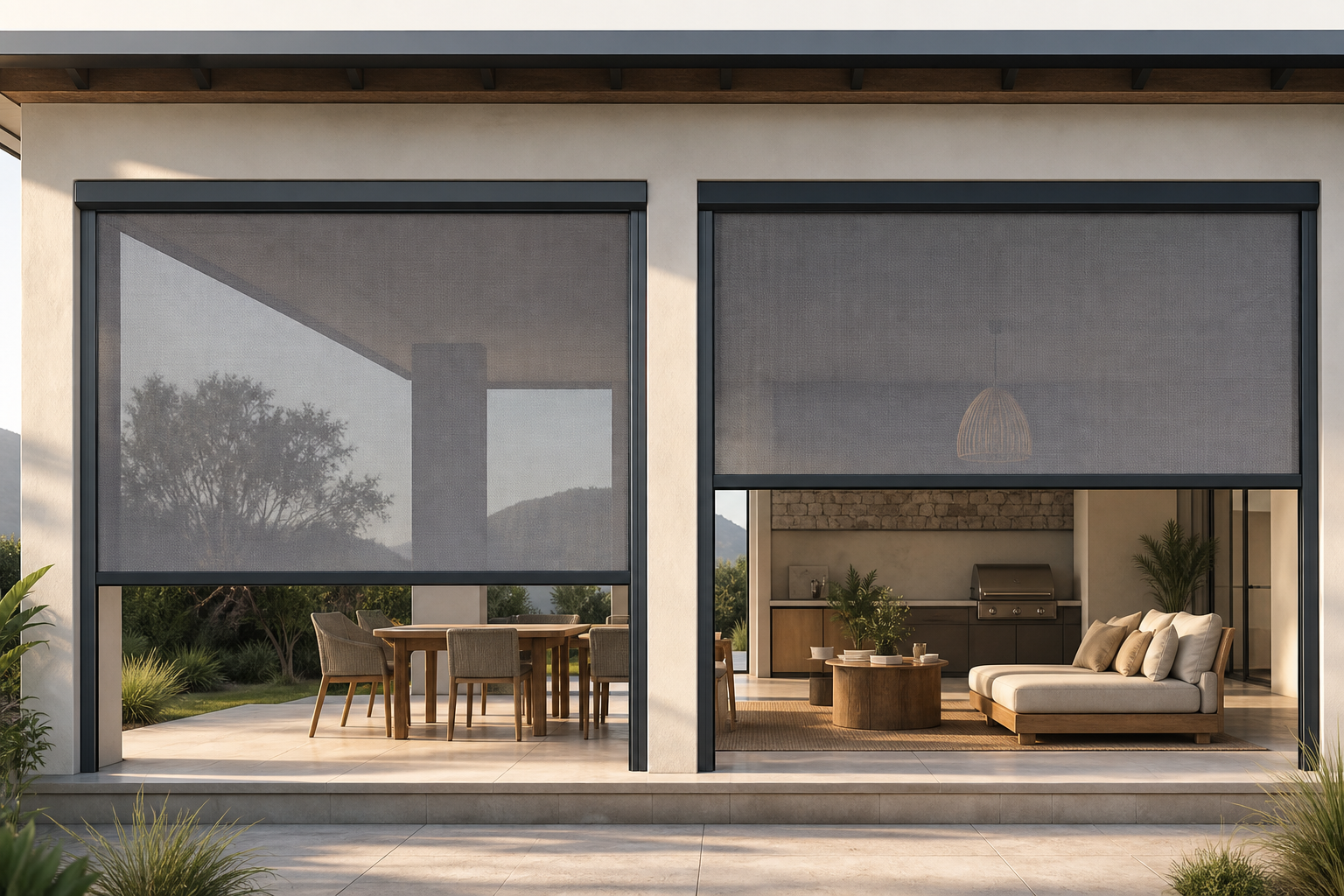
Compare side retention, exposure and daily operation before choosing
Channel-Guided vs Zip-Guided Outdoor Blinds: Which System Fits Your Patio?
Channel-guided and zip-guided outdoor blinds both add side control to a patio screen, but they do not retain the fabric in the same way. The right choice depends on the opening, exposure, material, span, fixing surfaces and how often the blind will be used. A measured site assessment should lead the decision.
Explore the complete outdoor blinds range, then request a measured patio consultation or WhatsApp 083 298 1740.
Why side guidance matters outdoors
A free-hanging outdoor blind drops vertically without fixed side guides. That can be a practical choice for a sheltered opening where flexible shade and privacy are the main needs. In a breezier or more frequently used space, side guidance can keep the blind aligned and reduce unwanted movement.
Side guidance does not turn a retractable screen into a permanent wall. Wind behaviour still depends on the system, width, drop, fabric, surrounding structure and site conditions. The blind must always be used within the supplier’s operating guidance.
How channel-guided outdoor blinds work
A channel-guided blind uses fixed vertical side channels to guide the bottom bar and keep the blind travelling in a controlled path. The fabric edges sit in relation to the guides, while the bottom bar remains aligned as the blind moves.
Where channel guidance can make sense
- Covered patios with straight, dependable fixing surfaces
- Openings that need more control than a free-hanging blind
- Frequently used entertainment areas where consistent alignment matters
- Projects where a defined architectural edge suits the patio structure
The opening should be checked for columns, wall irregularities, gutters, skirtings, doors and furniture. Side channels need suitable fixing points and enough clearance to run continuously from the headbox to the lower landing point.
How zip-guided outdoor blinds work
A zip-guided system retains the fabric edge continuously within the side guides. This creates closer edge control than a conventional guided bottom bar and can suit more exposed entertainment areas where the selected span, structure and material are appropriate.
Where zip guidance can make sense
- Patio openings that need closer fabric-edge retention
- Wide entertainment or hospitality openings assessed for a suitable system
- Projects where a tauter, more contained screen is visually important
- Sites where the structure can support accurate, parallel guide installation
Zip guidance is not a universal answer for severe weather. System limits, site exposure and correct operation still apply. Very large openings may need to be divided into multiple blinds so that each unit remains practical and properly supported.
Channel-guided and zip-guided blinds compared
| Planning point | Channel-guided | Zip-guided |
|---|---|---|
| Edge control | Guides the blind and bottom bar within fixed side channels | Retains the fabric edge continuously in the side guides |
| Typical brief | More alignment and control for a regularly used patio | Closer fabric retention for a more exposed or demanding opening |
| Fixing surfaces | Needs straight, secure side fixing points | Needs precise, parallel guides and suitable structure |
| Material choice | May use suitable mesh or clear material according to the system | Material and edge design must be compatible with the selected zip system |
| Weather claim | Retractable screening, not a permanent wall | Greater edge retention does not create complete weatherproofing |
| Maintenance | Keep guides clean and inspect alignment | Keep guides and retained edges clean; stop if movement becomes uneven |
Choose the material around the patio problem
Solar mesh for glare, shade and airflow
Solar mesh filters glare and preserves more daytime outward visibility. The weave and colour influence shade, view and privacy. Night-time privacy changes when lights are on inside the patio, so mesh should not be presented as complete evening screening.
Clear PVC for stronger weather separation
Clear PVC creates a more continuous barrier to everyday wind and wind-driven rain while keeping the view visible. Reflections, temperature changes and cleaning are part of living with a clear material. Small gaps may remain because the blind is retractable, and the surrounding roof and drainage still determine how the area handles rain.
Different sides may need different answers
A west-facing opening may benefit from mesh to manage glare, while another side may use clear PVC where the view and everyday weather separation matter more. The most effective specification follows each elevation instead of forcing one material onto the whole patio.
Assess wind exposure without guessing
Ask where the wind normally enters, which openings are most exposed and whether nearby walls channel gusts through the patio. Record conditions across seasons and at the times the area is normally used. A sheltered courtyard and an elevated coastal terrace should not receive the same recommendation simply because their openings are a similar size.
No retractable outdoor blind should be described as suitable for every wind condition. Confirm the exact operating guidance for the selected system and raise the blind when conditions fall outside those limits.
Plan wide openings and divisions
One wide blind is not automatically better than two or three aligned units. Dividing an opening can keep each blind within practical limits, follow structural columns and preserve access to doors or walkways. The divisions should be agreed before manufacture so headboxes, guides and bottom bars form a coherent architectural rhythm.
Manual or motorised operation?
Manual operation can suit accessible, moderate-size openings. Suitable motorisation can simplify wide, high, grouped or frequently adjusted outdoor blinds. The motor, power source, controls, grouping, integration compatibility and maintenance access must all be confirmed for the selected system.
In hospitality settings, decide who operates the blinds, where controls are located and how staff respond to changing weather. Convenience should support safe operation rather than replace it.
Measure the full patio, not only the opening
A reliable site survey records the clear width and drop, structural fixing surfaces, columns, doors, gutters, roof runoff, paving falls, furniture, braais, lights, electrical services and safe access. It should also document the direction of sun and wind and where the bottom bar will land.
- Define the priority. Rank glare, privacy, airflow, view and everyday weather separation.
- Map the exposure. Record sun and wind by time of day and season.
- Inspect the structure. Confirm straight fixing surfaces and clear travel paths.
- Compare guidance systems. Review free-hanging, wire, channel and zip options around the site.
- Select the material. Compare solar mesh and clear PVC in the actual light.
- Plan operation. Confirm manual or suitable motorised controls and maintenance access.
- Approve the divisions. Align multiple blinds with columns, doors and furniture.
Channel-guided vs zip-guided outdoor blinds FAQ
Are zip-guided blinds always better in wind?
They provide closer fabric-edge retention, but suitability still depends on the specific system, dimensions, material, structure and site exposure. There is no single outdoor blind for every wind condition.
Do channel-guided blinds stop rain?
They can reduce everyday wind-driven rain according to the material and installation, but retractable systems may have gaps and do not replace permanent walls or correct roof drainage.
Can both systems use solar mesh?
Suitable mesh may be available for different guided systems. Confirm compatibility, openness, colour and the expected balance of shade, airflow, view and privacy.
Can clear PVC be zip guided?
Material and edge construction must be compatible with the selected system. Confirm the exact product configuration rather than assuming every clear panel works in every guide.
Which system is better for a restaurant?
The answer depends on exposure, opening size, guest comfort, staff workflow, controls, emergency routes and maintenance. A site-specific commercial brief should lead.
Choose the guide system after the site visit
Send the project location, photographs from inside and outside, approximate dimensions and the main comfort problem. ART Lifestyle can compare channel-guided, zip-guided and other outdoor blind options around the real opening before a measured quotation.
Request an outdoor-blinds consultation, WhatsApp 083 298 1740 or visit www.artlifestyle.co.za.
One thought on “Channel-Guided vs Zip-Guided Outdoor Blinds: Which System Fits Your Patio?”