
Layering Curtains and Blinds: Plan the Track, Handles and Stack-Back

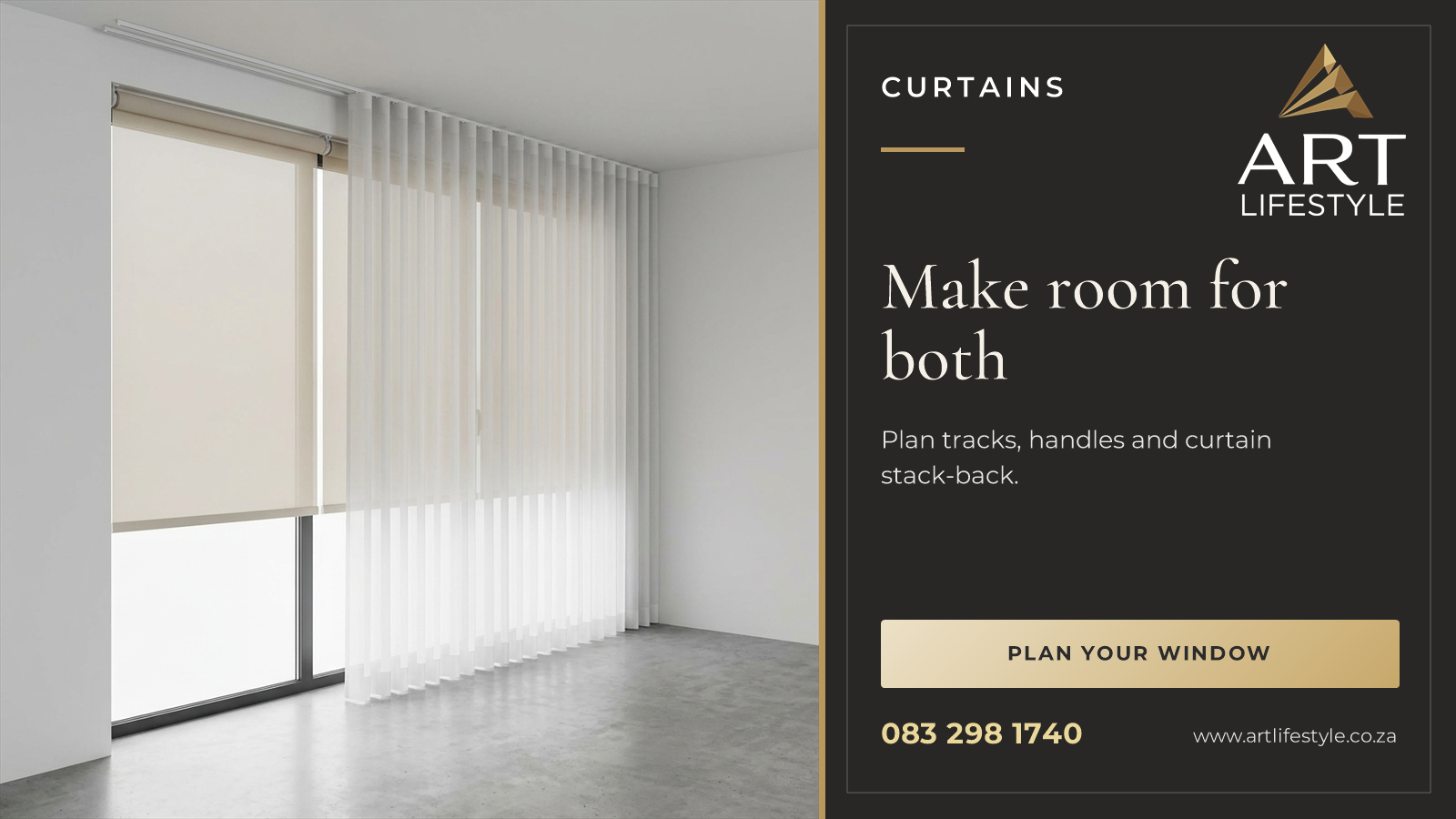
A layered window treatment is often chosen for its appearance: the clean line of a blind beside the softer folds of a curtain. To make that combination practical, plan how both layers move before choosing the final fabric. A blind, a curtain and an opening window all need their own space.
This guide focuses on the details to discuss at the measure. It is useful whether you are adding curtains to an existing blind or planning both together.
Give each layer a clear job
Start with a short sentence about what each layer should do. You might want the blind to manage daytime glare while the curtain provides a softer finish and the privacy you need in the evening. Another room may prioritise darkness, with both layers contributing to the result.
A roller blind can provide a compact inner layer, but the fabric and mounting position still need to suit the room. Check privacy in the conditions that matter to you rather than assuming that a sheer curtain or an open-weave blind will provide the same screening after dark.
Look at the window from the side
A straight-on photograph can hide the most important clearance problem. Take a second view from the side so that the recess, handle, sill and surrounding wall are visible. Show the window open as well as closed.
During the measure, discuss where the blind will travel and how far the handle projects. The curtain must also hang without rubbing on the blind or catching the handle. If the window tilts or opens into the room, its movement needs to be considered with both treatments in place.
Do not decide the final recess fit or fixing position from a photograph alone. The actual depth, surfaces and product hardware need to be checked.
Plan the track and the stack-back together
Stack-back is the space occupied by the curtain when it is drawn open. That space can affect how much glass is visible, how the room looks and whether a nearby door remains convenient to use.
Look beyond the width of the window. Is there usable wall on both sides? Does a corner, cupboard or doorway limit the track? Would the open curtain sit behind a chair or over part of the glass? These questions should be resolved before agreeing the layout.
The required stack depends on the fabric, heading and fullness, so avoid treating a standard extension on each side as a universal answer. Ask how the proposed curtain will gather in your specific layout.
Check the full movement sequence
Imagine an ordinary morning. You open the curtains, adjust the blind, reach the handle and open the window. Then consider the reverse sequence in the evening. Each step should have a clear path.
- Can the blind move without touching the curtain?
- Can you reach its control after the curtain is installed?
- Does the curtain clear the sill, furniture and floor as intended?
- Can doors and windows open with the treatments in their usual positions?
- Can the open curtain stack sit where planned without becoming an obstruction?
If motorisation is being considered, include the power and control arrangement in this conversation. Compatibility and access need confirmation for the selected system.
Compare fabrics in the complete room
Once the layout is workable, review samples beside the wall colour, flooring and upholstery. Look at them in daylight and under the lights you use in the evening. Hold the two materials together so that texture and colour are considered as a pair.
For a bedroom, describe the level of darkness you want. Opaque material does not automatically remove light around the edges of an installation. For a living area, consider the view and how the room should feel when only one layer is in use. The living-room light and privacy guide covers that broader choice.
Bring a simple opening-by-opening brief
For each window, gather a whole-wall photo, a side view and a note about its main purpose. Include nearby furniture that will remain in place. Approximate dimensions can help start the discussion, but final sizing and installation details need professional confirmation.
Before approving the specification, ask to confirm the blind position, curtain track, opening direction, stack location, fabric choices and controls together. That keeps the layered treatment focused on the way the room will actually be used.
Plan your layered window treatment
Explore indoor blinds and bespoke curtains with Art Lifestyle. Share your location, window count and photos, and explain what you would like each layer to achieve.
Visit Art Lifestyle or WhatsApp 083 298 1740 to discuss the next step for your project.